White Pocket Rot: The Minigame
2026-04-02
- mycology
- black spruce
- game
If you've swung an axe on a black spruce at the Scotty Creek Research Basin, or really in any boreal forest (particularly in western North America), you might've noticed the trunks of some of our conifer comrades riddled with small divots. Being the diligent and curious lumberjack that you are, when you take a closer look you might get lucky and see a fibrous white residue haunting these little hollows. This is the trademark pattern of decay aptly named White Pocket Rot.
White Pocket Rot is not itself a fungus or a mushroom, rather the phrase just describes the small pockets within a tree left behind by a parasitic fungi. It's not well defined what fungi leave this kind of decay in its wake, but suspects include Porodaedalea piceina and Onnia tomentosa. And yes, it's true - White Pocket Rot is the work of a parasitic fungus. When we talk about fungi, we can group them into one of three broad categories:
- Parasitic Fungi (Pathogens): These are fungi that attack living organisms.
- Saprobic Fungi (Decomposers): These are fungi that eat material which is already dead.
- Mycorrhizal Fungi (Partners): These fungi are mutualists, meaning they exchange nutrients with the organism to which they attach themselves.
In our case, we have a fungi attacking a living black spruce, making the culprit parasitic - unless of course there is a secret nutrient exchange going on. This could very well be the case, but I don't have an answer for you and you probably won't find one. White Pocket Rot and the fungi that leave it behind have barely been studied. But hey, if you're a graduate student in mycology looking for a project, I know a black spruce stand with a whole lot of White Pocket Rot.
What is known is this: fungi that leave White Pocket Rot behind are targeting lignin. Lignin is the natural "glue" that provides key structural support in plant cell walls. In our black spruce, an attack on the lignin might result in a loss of structural integrity or stiffness. You can imagine that this might make these conifers more vulnerable to breaking or falling. This is probably not ideal for me, seeing as my sleeping tent is beneath a couple of black spruce trees in a stand with known White Pocket Rot. But I'll now share with you the saddest truth I've ever come to face: not everything is about me.
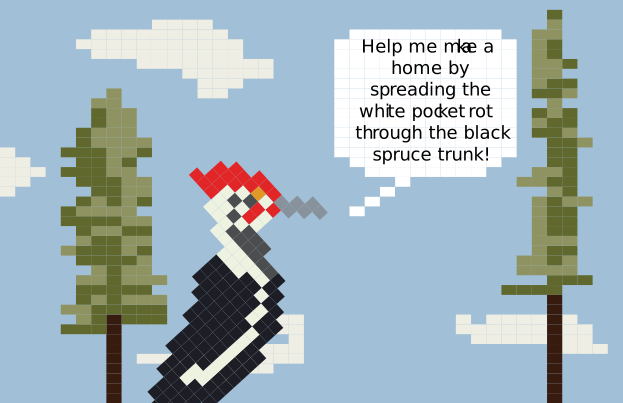
A weakening of the structural integrity of a black spruce tree isn't all bad. For example, a conifer with vacant pockets of decay is much easier for a woodpecker to excavate. In turn, all of our buddies who rely on woodpecker architecture, for examples owls, squirrels, and bats, might benefit from White Pocket Rot. It also stands to be true that a lot of these trees are pretty old, and the nutrients inside them are essentially locked away from the rest of the ecosystem. The fungi that leave White Pocket Rot behind consume those nutrients and reintroduce them to the soil. So ultimately, when we see White Pocket Rot, do not fret! Instead, we should rejoice in the hard work of our mycelium brethren and all of the opportunity it has created for the broader ecosystem.
Before you leave, play my white pocket rot minigame! You might be able to tell what my inspiration was :). Guide the spreading rot using the arrow keys. If the growth runs into the edge of the trunk or back into itself, the run ends. When the trunk is at least 25% decayed, hit Peck to move the woodpecker family into their new home.
P.S. I know those microscope pictures leave something to be desired in the way of quality, but this is the setup I'm workin' with here so cut me some slack:
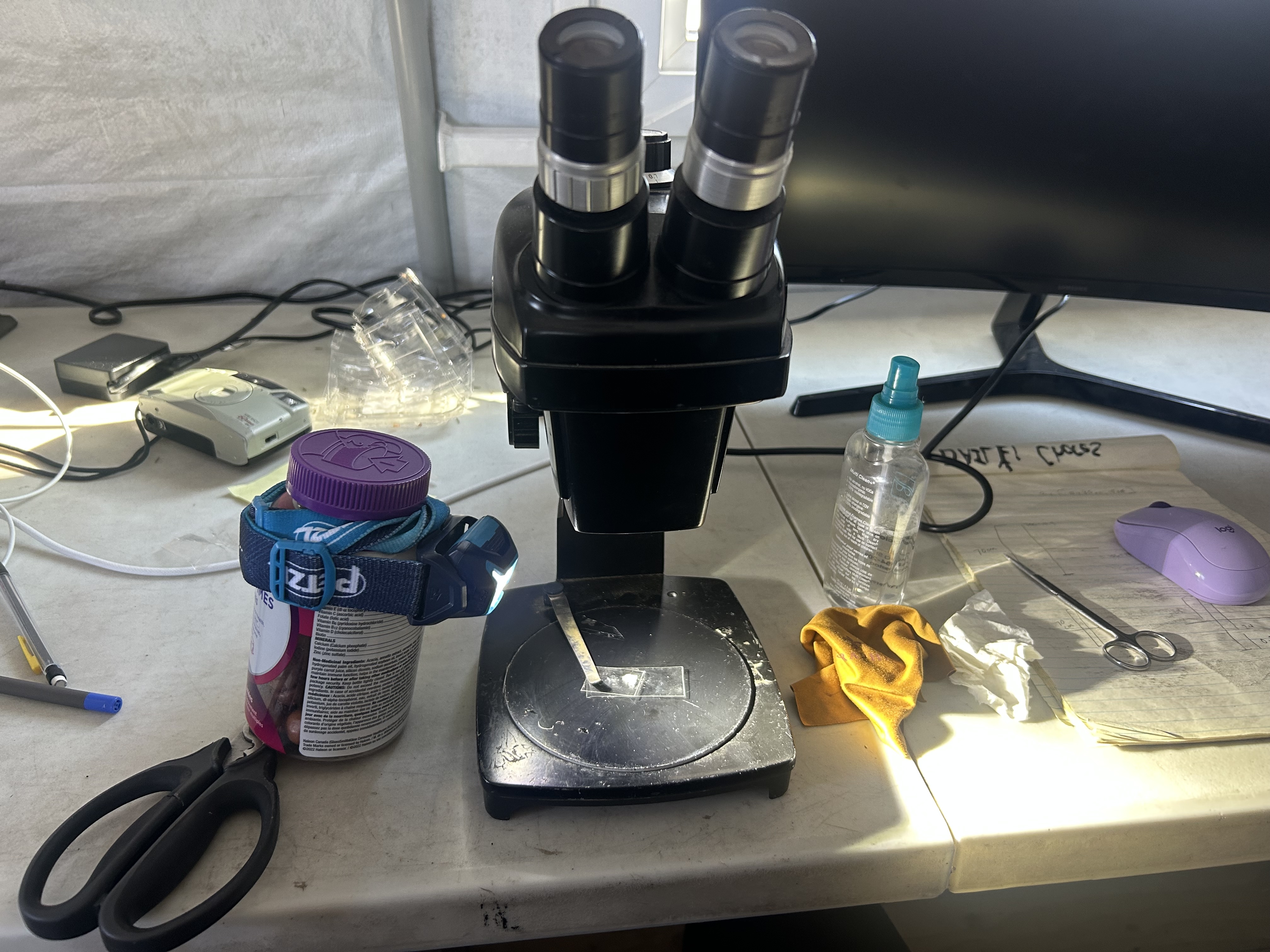
The slides are made out of a cut up cherry tomato carton :).